



Course 3D Print
Welcome to our page on 3D printing courses. 3D Actions holds 3D print courses for schools, private individuals and businesses. Here you will find everything you need to know about taking a 3D printing course – and if you are still in doubt, you are always welcome to call or write to us.

3D PRINT COURSE
courses for schools, private individuals and businesses

NON-BINDING OFFER
contact us for a 3D printing course offer

3D PRINT COURSE LEVEL
from beginner to experienced or advanced
COURSE 3D PRINTING
Learn everything about 3D printing technology
3D printing technology is an exciting and innovative technology that allows for the production of unique and customized objects in a fast and efficient way. With a 3D print course from 3D Actions, you can learn everything about 3D print technology and how you can use it to create your own unique designs and products.
Whether you are interested in taking a course for professional or personal use, you will find plenty of information here on our site. We cover everything from pricing and difficulty to what you can learn on a course and what to consider before signing up. So sit back and explore our site and let us help you start your journey into the world of 3D printing technology.
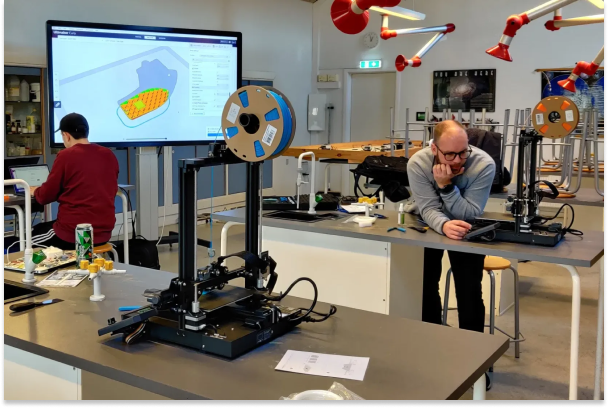
Course at Glamsdalens Sports After School
“Thank you for a good course to Simon, who both helped us with the purchase of 3D printers, and had a good presentation for our school, so we got started with 3D printing. Simon has subsequently been available for follow-up questions and help with setting up the 3D printers.
All in all, a good experience and a sense of thoroughness and great knowledge in the field.”

Rasmus Nygaard Christensen
Hear more about our 3D printing courses – contact us today
3D print course for
schools and institutions
Primary schools, after-schools, krea workshops for young people, yes we are not picky! Contact us immediately for a non-binding chat, and we will look at what you want from the course and how we can make the learning process best for your needs. Contact us immediately for a non-binding chat, and we will look at what you want get out of the course and how we can make the learning process best for your needs.
3D print – startup
This package is for schools that are completely green in 3D printing – or perhaps have seen a little about it on social media.
We go through the entire start-up:
Safety around the machines
Setting up the printers
Use of printer software (slicers)
Print your first model
Why is 3D printing the new thing in the classroom? And what can it be used for in the future?
About 4 hours
DKK 7500 ex. VAT (for 1-3 students and 1-3 machines)
FDM (general plastic)
Order selected 3D printers and filament through us and get a discount. We can create the perfect start-up package for your needs.
*Printers, equipment and material not included in the price
*The price is indicative and can be found according to individual wishes
3D print – get better print
Do you already have a good handle on 3D printing, but don’t think the results are quite as they should be? With this course, we help you go one step further and get closer to a professional print.
The course mainly goes through:
Which software & slicer can do what
Which materials are best for which projects
What needs to be tuned for a certain result
General advice and recommendations
About 3 hours
DKK 9,500 ex. VAT (for 1-3 students, for 1-10 students)
FDM (general plastic)
Order selected 3D printers and filament through us and get a discount.
*Printers, equipment and material not included in the price
*The price is indicative and can be found according to individual wishes
3D printing course
for companies
The local carpenter who sees potential in the 3 dimensions, an architect who wants to see his design in reality or perhaps an electronics company that uses countless iterations on product development?
If you already have a handle on 3D printing, or want to hear about what it can do for you, we are ready with a non-binding chat, and maybe a few tips along the way.
Should your interest be in a few models to be printed, you can also order from us directly in our business center, otherwise a course in 3D print start-up or optimizing your 3D print process is absolutely the best for you!
3D print – startup
This package is for companies that want to dive into how 3D printing can optimize their production, product development and much more!
We go through the entire start-up:
Safety around the machines
Setting up the printers
Use of printer software (slicers)
Print your first model
Why is 3D printing the new thing in the classroom? And what can it be used for in the future?
About 4 hours
DKK 7500 ex. VAT (for 1-3 students and 1-3 machines)
FDM & DLP/SLA
Order selected 3D printers and filament through us and get a discount.
*Printers, equipment and material not included in the price
*The price is indicative and can be found according to individual wishes
3D print – optimization
Does your workplace already have one or more 3D printers, but lack more knowledge so that they can serve themselves back home? Then the optimization package is the one you should choose!
The course mainly goes through:
What types of projects do you print the most?
How can these print tasks be optimized for the purpose
How to spend less time on misprints
General advice and recommendations
About 3 hours
FDM & DLP/SLA
FDM & DLP/SLA
Order selected 3D printers and filament through us and get a discount.
*Printers, equipment and material not included in the price
*The price is indicative and can be found according to individual wishes

Why choose 3D Actions for your 3D printing course?
Courses within IT and machinery can often be very advanced or not interesting for its students. We have solved this at 3D Actions, as we very quickly get away from the side seats and get started with the machines.
In addition to the great experience and expertise we have in 3D printing, the use of various slicers and materials, we also offer to tailor parts of the course to your needs. Do you have several problems with a certain material, or do you print in the same model several times? Then they may be that we have to take a different approach than first assumed.
You can benefit from all this and much more by choosing a course from us at 3D Actions.
COURSE 3D PRINTING
How much does a 3D
printing course cost?
The price of a 3D print course can vary depending on the duration, content and level of the course and costs from DKK 2,500 per person incl. VAT for a physical course. Here, a start-up course will cost DKK 7,500 for up to 3 course participants. The price varies depending on whether the course is online or at a physical location. If you are, for example, a school, the price will drop drastically per student, as we can fill a room. However, always contact us in advance to discuss your needs and course price.
It is also worth noting that our 3D printing courses require that you have access to your own 3D printer or to a 3D printer at the location of the course. This can affect the total price if you do not already have access to a 3D printer, as you yourself or we will take care of ordering the machines and equipment for the start of the course.
COURSE 3D PRINTING
Where can I get a 3D printing course?
3D actions holds courses in 3D printing throughout Denmark, Copenhagen, Aarhus, Odense or Aalborg – and we are happy to come to you. We typically hold 3D printing courses at schools or workplaces, but it is also possible to join together as private individuals who want to know more about 3D printing. Contact us today to hear more about the possibilities.
Hear more about our 3D printing courses – contact us today
What should I consider before taking a 3D printing course?
Before taking a 3D printing course, there are some things you can consider to get the most out of your experience:
Your goals and expectations: Think about what you would like to achieve from the course and what skills or techniques you would like to learn.
Your previous experiences with 3D print technology and design: If you already have experience with 3D print technology and design, you can consider more advanced courses. If you are a beginner, a basic course may be more appropriate.
Course level and content: Choose a course that suits your level and interests and covers the skills and techniques you want to learn.
Course duration and schedule: Think about whether the course duration and schedule fits your calendar and work schedule.
The cost of the course: Think about whether the cost of the course fits your budget and whether the course offers any kind of subsidy or financial support.
Availability of 3D printer: If the course requires you to have access to a 3D printer, be sure to investigate whether a printer is available or whether it needs to be purchased before the course starts.
Course instructors and reputation: Be sure to research the course instructors and their experience and reputation in the industry, so you can be sure that you will receive a high quality of instruction.
Overall, it is important to find a course that suits your needs and goals and that gives you the knowledge and skills you need to achieve your goals in 3D printing technology and design.
COURSE 3D PRINTING
Is the 3D print course difficult?
The degree of difficulty of our 3D printing course can vary depending on the level and content of the course as well as the individual participants’ previous experience with 3D printing technology and design. Some of our 3D printing courses can be quite basic and have a low level of difficulty, while other courses can be more advanced and require more technical knowledge and experience.
If you have never worked with 3D printing technology before, a basic 3D printing course can be a good start, where you can learn the basic techniques and concepts within 3D printing technology and design. These courses will usually be of low difficulty and will be accessible to everyone.
If you already have experience with 3D printing technology and design, you should consider our more advanced 3D printing courses, which will have a higher degree of difficulty and will require more technical knowledge and skills. These courses will be more challenging, but can provide more advanced knowledge and skills in 3D printing technology and design.
Regardless of your previous experience and level, we have a well-structured 3D printing course with a step-by-step approach to learning and will provide sufficient support and guidance for all participants – schools, business or private
What can I learn on a 3D printing course?
On a 3D printing course you can learn a number of skills and techniques related to 3D printing.
Here are some of the topics you can expect to learn about, depending on the type of course you want, first in point form and then in more detail:
Introduction to 3D printing: You will learn about basic concepts within 3D printing, including different types of 3D printers and their areas of application.
3D print materials and techniques: You will be introduced to different materials that can be used for 3D printing, such as PLA, ABS, PETG and many more. You will also learn about different printing techniques such as Fused Filament Fabrication (FFF), Stereolithography (SLA) and Selective Laser Sintering (SLS).
3D Design and Modelling: You will learn to use 3D modeling software, such as Tinkercad, Fusion 360 or Blender, to design and create your own 3D models. You will also learn about the importance of optimizing your design for 3D printing.
Slicing and print options: You will learn about slicing software, such as Cura or Simplify3D, and how to use them to convert your 3D models into printable files. You will also learn about important print settings such as layer height, infill, speed and temperature.
3D printing problems and troubleshooting: You will learn to identify and solve common printing problems, such as poor adhesion, stringing, warping and more. You will also learn about maintenance and calibration of your 3D printer.
Finishing and finishing methods: You will learn about different methods to enhance and complete your 3D printed objects, such as sanding, painting, gluing and acetone treatment.
Applications and industries: You will be introduced to various areas of application for 3D printing, such as prototyping, manufacturing, art, medicine and architecture.
WHAT CAN I LEARN ON A 3D PRINTING COURSE?
Introduction to
3D printing
By taking a 3D printing course, you will develop a solid understanding of the world of 3D printing and gain skills that can help you create your own 3D printed projects and products.
Introduction to 3D printing is an important part of any 3D printing course as it provides a solid foundation for understanding this fascinating technology. 3D printing is an additive manufacturing method where objects are built up layer by layer by depositing or hardening material. This process differs from traditional manufacturing methods, such as milling or casting, where material is removed or shaped.
The history of 3D printing goes back to the 1980s, when the first 3D printers were developed. Since then, the technology has advanced significantly and has become more accessible to professionals and hobbyists alike. Today there are different types of 3D printers that use different technologies and materials to build objects. Some of the most common technologies are Fused Filament Fabrication (FFF), Stereolithography (SLA) and Selective Laser Sintering (SLS).
Fused Filament Fabrication (FFF), also known as Fused Deposition Modeling (FDM), is the most popular and available 3D printing technology. This type of printer heats a plastic material, which is typically in the form of a thread, and deposits it in thin layers to build the object. FFF printers are known for their versatility and relatively low cost, making them ideal for hobbyists and small businesses.
Stereolithography (SLA) is another type of 3D printing technology that uses light, often a UV laser, to harden a liquid plastic material called photopolymer. SLA printers are capable of producing objects with very high precision and detail, but they can be more expensive and require more maintenance than FFF printers.
Selective Laser Sintering (SLS) is a 3D printing technology that uses a laser to melt and fuse powdered materials, such as plastic, metal or ceramics, to build objects. SLS printers can produce very strong and complex objects, but they are often more expensive and require more advanced equipment and expertise to operate.
By learning about the basic concepts and technologies within 3D printing, you will be better equipped to understand and choose the right technology and method for your own 3D printed projects and products.
WHAT CAN I LEARN ON A 3D PRINTING COURSE?
3D printing
Materials and techniques
Materials and techniques in 3D printing are essential to achieve successful results in your projects. There is a wide range of materials and techniques, each with different properties and uses.
One of the most common materials for 3D printing is polylactic acid (PLA). PLA is a biodegradable thermoplastic that is easy to work with and has a low melting temperature. It is popular with hobbyists and beginners as it is easy to print with and environmentally friendly. PLA is suitable for non-loaded objects and models with lower mechanical requirements.
Acrylonitrile Butadiene Styrene (ABS) is another popular material for 3D printing. ABS is a strong and durable plastic that is resistant to temperatures and impacts. ABS requires higher print temperatures and a heated build plate to avoid shrinkage and deformation during printing. ABS is ideal for mechanical parts and objects that must withstand higher loads and temperatures.
WHAT CAN I LEARN ON A 3D PRINTING COURSE?
3D printing
Materials and techniques
Polyethylene Terephthalate Glycol (PETG) is an additional material that combines the strength and durability of ABS with the lightweight properties and easy print conditions of PLA. PETG is popular for functional parts and objects that require both strength and flexibility.
In addition to the basic materials, there are also special materials such as flexible filaments, wood- and metal-filled materials and temperature-sensitive materials that change color with temperature. These materials can be used to create unique and specialized objects with different properties and uses.
The different materials require different techniques and settings to achieve optimal print results. For example, some materials require a heated build plate, while others require cooling during printing. It is important to understand how the materials behave during the printing process and adapt your techniques and settings accordingly.
By learning about the different materials and techniques in 3D printing, you can choose the right one material for your projects and master the techniques required to achieve the best results.
Hear more about our 3D printing courses – contact us today
WHAT CAN I LEARN ON A 3D PRINTING COURSE?
3D Design and modelling
3D Design and modeling is a central part of 3D printing, as it involves creating digital 3D models that will later be printed as physical objects. In order to achieve accurate and successful 3D printing, it is important to master this phase of the process, as designing for 3D printing is its own art.
There are various 3D modeling software that can be used to design and create 3D models, ranging from simple, beginner-friendly programs to more advanced and professional tools. For those new to 3D design, Tinkercad is a popular choice as it is a free, web-based application that offers an easy and intuitive way to design 3D models. Tinkercad is particularly suitable for small projects and rapid prototyping.
WHAT CAN I LEARN ON A 3D PRINTING COURSE?
3D Design and modelling
When designing 3D models for printing, it is important to consider certain factors to ensure that the model is printable and functional. This includes considerations such as wall thickness, support structures, orientation of the object on the building plate and material selection. Optimizing your design for 3D printing can save time, material and prevent errors during the printing process.
By learning about design and modeling in connection with 3D printing, you will gain the necessary skills and tools to create your own 3D models and adapt them to your specific projects and needs
WHAT CAN I LEARN ON A 3D PRINTING COURSE?
3D Design and modelling
For more advanced users, Autodesk Fusion 360 is a popular option as it is a professional 3D modeling software that provides users with a variety of powerful tools to design and construct complex objects. Fusion 360 is ideal for engineers and designers working with mechanical parts, assemblies and complex geometries.
Blender is another advanced and versatile 3D modeling software that is popular among amateurs and professionals alike. Blender is an open source application that offers a comprehensive set of tools for designing, animating and rendering 3D models. It is particularly suitable for artists and designers who want to create detailed and realistic models for animations, video games and other visual projects.
WHAT CAN I LEARN ON A 3D PRINTING COURSE?
Slicing and print settings
In the 3D printing process, finishing plays a crucial role, as this is where the printed objects get their final appearance and functionality. Proper finishing can improve the appearance, strength and durability of the printed parts, as well as give them a professional finish. Depending on the material used and the desired result, finishing methods can vary considerably.
After removing any support structures, a basic finishing process can consist of removing any impurities, threads or unevenness that have occurred during the printing process. This can be done using a hobby knife, sandpaper or a spatula. Careful sanding of the surface can also help smooth and improve the appearance of the printed object.
WHAT CAN I LEARN ON A 3D PRINTING COURSE?
Slicing and print settings
For some materials, such as PLA, additional finishing may include a chemical smoothing using a solution such as tetrahydrofuran (THF) or ethyl acetate. These solvents can be used gently on the surface of the object to smooth and remove roughness, but it is important to take precautions and work in a well-ventilated area when working with chemicals.
When using ABS acetone can be used to smooth and improve the surface of the printed object. Acetone vapor straightening is a popular technique where the object is exposed to acetone vapors for a short period of time. The steam process gently melts the surface of the ABS, resulting in a smoother and glossier finish.
For 3D printed objects made using resin-based technologies, such as SLA, finishing is often a necessary part of the process. After printing, resin objects must be cleaned to remove any remaining UV-cured resin and then cured using UV light to achieve final strength and durability.
WHAT CAN I LEARN ON A 3D PRINTING COURSE?
3D printing problems and troubleshooting
3D printing issues and troubleshooting is an important part of the 3D printing process as it helps you identify and resolve any issues that may arise during printing. By learning about the most common printing problems and how to solve them, you can improve print quality and reduce the risk of failed prints.
A common problem in 3D printing is poor adhesion to the build plate, which can result in the object becoming detached during the printing process and causing errors. This problem can often be solved by adjusting the level of the build plate, cleaning the plate of grease and dirt, applying an adhesive such as tape or glue, or increasing the temperature of the build plate if appropriate for the material you are printing with.
Another common challenge is stringing, where the filament pulls thin threads between separate parts of the object. Stringing can be caused by a number of factors, such as too high a temperature, too slow retraction or insufficient cooling. By adjusting these settings, you can minimize or eliminate stringing and achieve a cleaner print.
Irregularities and holes in the surface of the printed object can also occur due to inconsistent layers or under-extrusion. This can be due to factors such as clogged nozzles, inconsistent filament diameter, or incorrect extrusion settings. By cleaning the nozzle, checking the filament quality and adjusting the extrusion settings, you can improve the print quality and achieve a smoother surface.
WHAT CAN I LEARN ON A 3D PRINTING COURSE?
Finishing and finishing method
Over-extrusion is another problem that can lead to lumpy, distorted or merged parts. Overextrusion can be caused by wrong settings such as too high extrusion multiplier, wrong nozzle size or too low layer height. By adjusting these parameters, you can reduce overextrusion and achieve a more accurate and well-defined print.
Troubleshooting and solving printing problems is an important part of 3D printing, as it allows you to optimize your printing process and achieve the best results. By learning about the most common printing problems and how to solve them, you’ll be better equipped to handle the challenges of 3D printing and create successful, high-quality prints.
After removing any support structures, a basic finishing process can consist of removing any impurities, threads or unevenness that have occurred during the printing process. This can be done using a hobby knife, sandpaper or a spatula. Careful sanding of the surface can also help smooth and improve the appearance of the printed object.
For some materials, such as PLA, additional finishing may include a chemical smoothing using a solution such as tetrahydrofuran (THF) or ethyl acetate. These solvents can be used gently on the surface of the object to smooth and remove unevenness, but it is important to take precautions and work in a well-ventilated area when working with chemicals.
When using ABS, acetone can be used to smooth and improve the surface of the printed object. Acetone vapor straightening is a popular technique where the object is exposed to acetone vapors for a short period of time. The steam process gently melts the surface of the ABS, resulting in a smoother and glossier finish.
For 3D printed objects made using resin-based technologies, such as SLA, finishing is often a necessary part of the process. After printing, resin objects must be cleaned to remove any remaining UV-cured resin and then cured using UV light to achieve final strength and durability.
3D PRINT COURSE?
Finishing and finishing method
Finishing and finishing methods are an essential part of the 3D printing process, as they give the printed objects their final appearance and functionality. Proper finishing can improve the quality, strength and durability of the printed parts, as well as give them a professional finish. Depending on the material used and the desired result, finishing methods can vary considerably.
After removing any support structures, a basic finishing process can consist of removing any impurities, threads or unevenness that have occurred during the printing process. This can be done using a hobby knife, sandpaper or a spatula. Careful sanding of the surface can also help smooth and improve the appearance of the printed object.
3D PRINT COURSE?
Finishing and finishing method
For some materials, such as PLA, additional finishing may include a chemical smoothing using a solution such as tetrahydrofuran (THF) or ethyl acetate. These solvents can be used gently on the surface of the object to smooth and remove unevenness, but it is important to take precautions and work in a well-ventilated area when working with chemicals.
When using ABS, acetone can be used to smooth and improve the surface of the printed object. Acetone vapor smoothing is a popular technique where the object is exposed to acetone vapors for a short period of time. The steam process gently melts the surface of the ABS, resulting in a smoother and glossier finish.
For 3D printed objects made using resin-based technologies, such as SLA, finishing is often a necessary part of the process. After printing, resin objects must be cleaned to remove any remaining UV-cured resin and then cured using UV light to achieve final strength and durability.
In addition to the methods mentioned, additional finishing may include painting, varnishing or sealing the object to improve its appearance and protect it from wear, moisture and UV exposure. By mastering finishing techniques, you can give your 3D printed objects a professional and durable appearance that meets your specific requirements and needs.
WHAT CAN I LEARN ON A 3D PRINTING COURSE?
Applications and industry
Art and design is another area where 3D printing has found a place, enabling artists and designers to create unique and complex works previously not possible with traditional manufacturing methods. From sculptures and jewelry to fashion and furniture, 3D printing opens up new possibilities for creative expression and innovation.
The education sector has also embraced 3D printing as a tool to enhance learning and teaching. Students and teachers can use 3D printers to make models, prototypes and tools that can help explain complex concepts and promote hands-on learning.
These are just a few examples of how 3D printing is used in different industries and sectors. As technology continues to advance and new materials and methods are discovered, 3D printing will undoubtedly continue to develop at a rapid pace.
Within medicine and the healthcare sector, 3D printing has had a significant impact on the development of medical devices, prostheses and implants. Using patient-specific data, doctors and researchers can create customized prostheses, surgical guides, and even biological structures, such as tissues and organs, that are tailored to the individual patient’s needs.
Architecture and construction also benefit from 3D printing, enabling the production of detailed and accurate scale models as well as components and building materials for use in construction. New methods such as concrete printing are changing the way buildings and infrastructure are constructed, reducing costs and environmental impact.
Art and design is another area where 3D printing has found a place, enabling artists and designers to create unique and complex works previously not possible with traditional manufacturing methods. From sculptures and jewelry to fashion and furniture, 3D printing opens up new possibilities for creative expression and innovation.
The education sector has also embraced 3D printing as a tool to enhance learning and teaching. Students and teachers can use 3D printers to make models, prototypes and tools that can help explain complex concepts and promote hands-on learning.
These are just a few examples of how 3D printing is used in different industries and sectors. As technology continues to advance and new materials and methods are discovered, 3D printing will undoubtedly continue to develop at a rapid pace.
Hear more about our 3D printing courses – contact us today
